Training in St Lucia

Technical Training Solutions are delighted to have been chosen to provide training in St Lucia, an Eastern Caribbean island nation with a pair of dramatically tapered mountains, the Pitons, on its west coast. Its coast is home to volcanic beaches, reef-diving sites, luxury resorts and fishing villages. Trails in the interior rainforest lead to waterfalls like the 15m-high Toraille, which pours over a cliff into a garden. The capital, Castries, is a popular cruise port.
A programme to provide certification to electricians and engineers started in February 2017. Electrical Engineering Experts Inc. of St. Lucia, in partnership with Technical Training Solutions and the Division of Technical Education and Management Studies (DTEMS) of the Sir Arthur Lewis Community College (SALCC), began by teaching the UK City and Guilds industry-standard training/qualification in the Requirements for Electrical Installations - IET Wiring Regulations. These regulations govern electrical wiring in Saint Lucia and other countries making the certification an important achievement for electricians and engineers who previously received training for licensing for electrical installations. A series of 4 day training workshops is being offered at different periods throughout the year at Lucelec’s Electronics Workshop in DTEMS at SALCC. The UK IET Wiring Regulations (BS 7671) is adopted as SLNS/BS 7671 in St Lucia and it is the electrical standard by which all electrical installations should be designed, installed, inspected, tested, and maintained on the island. It is also the standard by which it is powered by the electricity supplier, Lucelec.

Chief Executive Officer of Electrical Engineering Experts Inc. Saint Lucia Mr Clive Antoine says "the training course will be of tremendous benefit to installation and maintenance electricians; refrigeration and AC technicians; electrical installers; electrical testers and inspectors, designers, engineers, drafters and architects." He says "a core objective of the course is to promote the use of the standard itself to equip participants with the knowledge and the requirements of the IET Wiring Regulations, Requirements for Electrical Installations". The four day programme culminates with the online City and Guilds examination at the CAD lab of DTEMS, SALCC. The IET Wiring course is worth 4 UK Education Credits. This training course is the prerequisite for the City and Guilds Inspection, Testing and Certification of Electrical Installation course which will be held later. This is specialized training that provides core knowledge and skills that all electrical inspectors and testers, electricians, electrical designers, and engineers need to possess. The Inspection and Testing course is worth 5 UK Education Credits.
Several other courses have also been provided: Electrical Safety on Construction Sites, Temporary Electrical Systems and Explosive Atmospheres / Hazardous Areas. All these courses have subject areas that greatly interest the candidates in St Lucia and we are very proud to be part of this project, which aims to bring Standards on the Island up to UK levels.
 |
 |
 |
View from the Auberge Seraphim Hotel |
Sir Arthur Lewis Community College, |
Looking down on Soufriere |
For a description of the IET Wiring Regulations course, go to
Course 310 - BS7671: IET Wiring Regulations
For a description of the C&G Inspection and Testing course, go to
Course 340 - Inspection, Testing and Certification of Electrical Installations (C&G 2391)
For a description of the Electrical Safety on Construction Sites course, go to
Course 375 - BS7375: Construction Site Safety
For a description of the Temporary Electrical Systems course, go to
Course 370 - BS7909: Temporary Electrical Systems
For a description of the Explosive Atmospheres / Hazardous Areas course, go to
Course 390 - ATEX / Hazardous Areas
Training in Montserrat
Our visit to the lovely island of Montserrat in 2016 was in order to provide a 3 day course on electrical safety and the IET Wiring Regulations.
Montserrat is a Caribbean island in the Leeward Islands, which is part of the chain known as the Lesser Antilles, in the British West Indies. It is a British Overseas Territory. It measures approximately 10 miles long and 7 miles wide, with approximately 25 miles of coastline. Montserrat is nicknamed The Emerald Isle of the Caribbean both for its resemblance to coastal Ireland and for the Irish ancestry of many of its inhabitants. Given its British status, the UK Wiring Regulations are enforced in Montserrat, which is why Technical Training were asked to educate some of the local engineers on the requirements of the British Standard.
The training was funded by the BNTF (Basic Needs Trust Fund) on behalf of the DMCA (Disaster Management Co-ordination Agency) at their head offices in Montserrat.
The candidates were taught about the dangers of electricity and safe working practices, along with the current edition of the IET Wiring Regulations. They sat an examination at the end of the course and were all successful in attaining good grades, proving they had achieved a high level of understanding of the Regulations.
 |
 |
 |
Katy Hill, Montserrat |
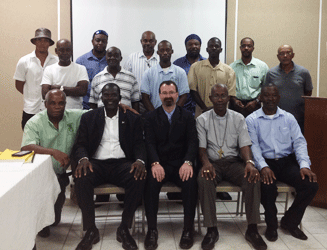
Front Row from left: The BNTF Project Manager Mr Mervin Browne, the Minister of Agriculture The Honourable Claude Hogan, Our Instructor Lee Woodfine, Parish Priest the Rev Father Carlisle Vyphuis and Chief Electrical Inspector of the Physical Panning Unit Mr Alvin Ryan. Behind them are the successful course candidates. |
Jack Boy Hill, Montserrat |
[Top of page]
NEW Courses
The most recently introduced new course from Technical Training Solutions is the Electrical Safety Management course.
The Electrical Safety Management course is intended for Engineering and Maintenance Managers and other employees who have responsibilities for policies / procedures or the allocation of work or the condition of equipment.
For more information on this course, please click on the following link:
Course 360 - Electrical Safety ManagementWe have also recently made some updates to the existing courses:
The 2394/5 Inspection & Testing qualifications were discontinued by City and Guilds and a new qualification introduced instead: the 2391. Changes have been made to the C&G examination process so that there are now three separate examinations; a short-answer written exam paper, a multiple-choice computer-based exam and the practical assessment. The examinations are open-book - the candidates are allowed to refer to the Regs etc - meaning that the futile attempt to memorise large swathes of the Regulations in the previous versions of the qualification is no longer necessary. This in turn allows us to concentrate our teaching efforts on the practical side - ensuring that the candidates are actually able to do the inspection and testing (and do it safely). The course has therefore been updated to reflect these changes and the new course is far better than the previous versions.
Please click on the following link to read more about the 2391 Inspection and Testing course:
Course 340 - Inspection & Testing of Electrical Installations
The 2391-20 Electrical Design qualification was discontinued and a replacement qualification (the 2396) introduced. This has an increased emphasis on the project work, so that it is now expected that the project will take 40 hours to complete. Several other minor changes have been made to the examination process. The 2396 is now a Level 4 qualification.
Please click on the following link to read more about the 2396 Electrical Design course:
Course 350 - Design of Electrical Installations
Nigerian Project
Technical Training Solutions has been providing training in Port Harcourt, Nigeria, as part of a major project to improve the employability of the local people.
With an economy growing faster than the US, the UK, Germany or France, GDP figures in excess of $270 billion, a population of 170 million and an average age of 19, Nigeria is set to become one of the world's largest economies in the future. This may happen sooner than anybody expects, and is likely to be accelerated by the latest initiative from Shell (SNEPCO), Aker Solutions, Petrosmart and Technical Training Solutions.
While the economy grows and standards of living improve, increasing pressure from native Nigerians has ensured that government and large employers in Nigeria are looking for ways to employ more of the local people in the oil and gas industries: creating better 'local content'. This has been difficult in the past given the weaknesses of the training and education sector in Nigeria.
Technical Training Solutions has been engaged by Petrosmart to alleviate this problem by providing their own training courses in Nigeria, bringing a completely fresh approach to Nigeria with industrially-focused and competence-based training, ensuring that the candidates gain a range of practical engineering skills, thereby making them attractive to large employers in the oil and gas industries.
With such a strong ethical basis to the project, Technical Training Solutions have been keen to get involved - despite advice from the UK Foreign Office not to travel to Nigeria.
 |
 |
 |
Aker Solutions, Petrosmart |
Petrosmart's training |
Some of the 2012 |
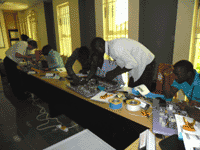
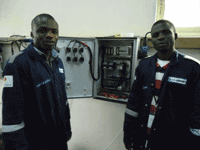
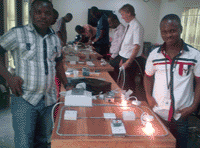
The courses provided so far are the electrical maintenance skills (industrial and building services), mechanical maintenance skills and the instrumentation course. All the equipment needed for the courses - nearly a tonne in weight - was constructed in the UK and transported by air freight to Nigeria. This has ensured that the courses are exactly the same as they would have been in the UK.
 |
 |
 |
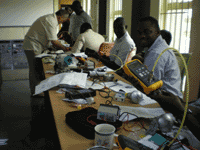
Week 1 of the Electrical |
Week 2 of the Electrical |
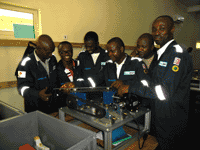
The Electrical Maintenance |
 |
 |
 |
The Mechanical |
The Instrumentation Course |
With a new intake of candidates each year, the four courses will be repeated in 2013 onwards. With the addition of the pneumatics and welding courses and an extended version of the building services course (so that it teaches candidates how to install a complete electrical installation, including back-up generators), the future for this superb project looks good and Technical Training Solutions are delighted to be a part of it.
Technical Training support WorldSkills UK competitions
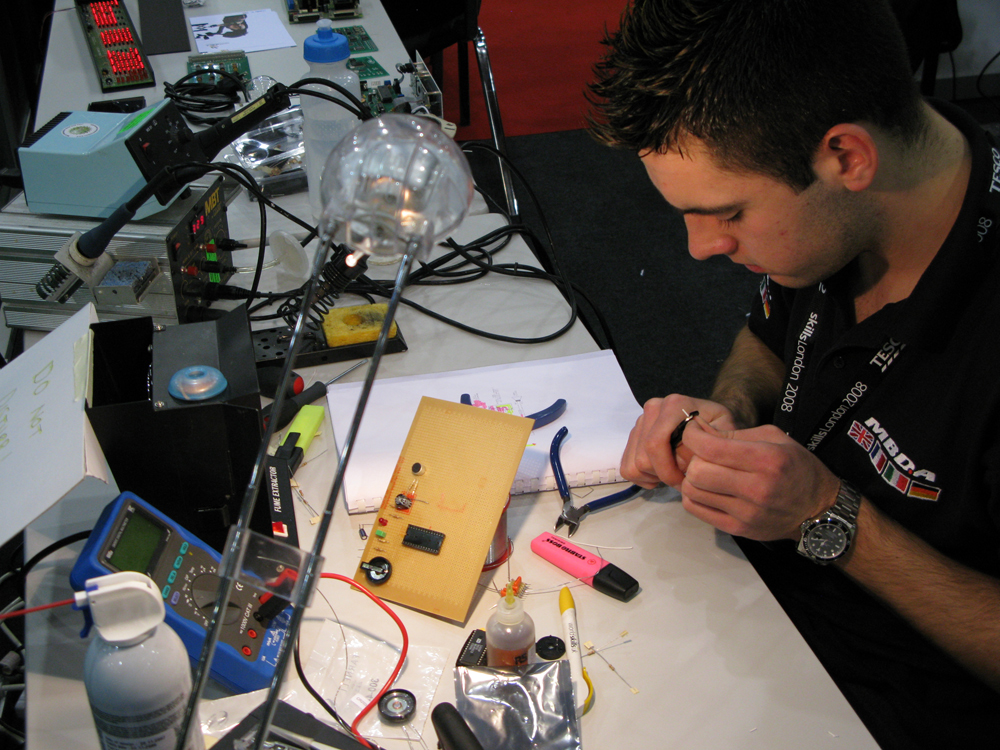
Technical Training have been providing training for entrants to the WorldSkills UK Electronics competition. Electronics Faultfinding has been recognised as an area of expertise that the competitors benefit from and they have therefore been attending a variety of training courses targeted to provide them with the skills and knowledge needed to achieve success. Technical Training have also been providing help with the judging at the UK competition.
Gareth Humphreys MBE, WorldSkills Electronics expert said "We see the Electronics training that Technical Training Solutions provide as absolutely essential to the success of our competitors".
 |
 |
 |
The importance of these competitions to the UK has been recognised by government and other sponsors: Skilled people are vital to the success of the economy and to succeed in these careers they need to be highly skilled and therefore highly trained. It is widely recognised that the UK's skills are not world-class and that they must be if it is to achieve the economic and social goals that we all aspire to.
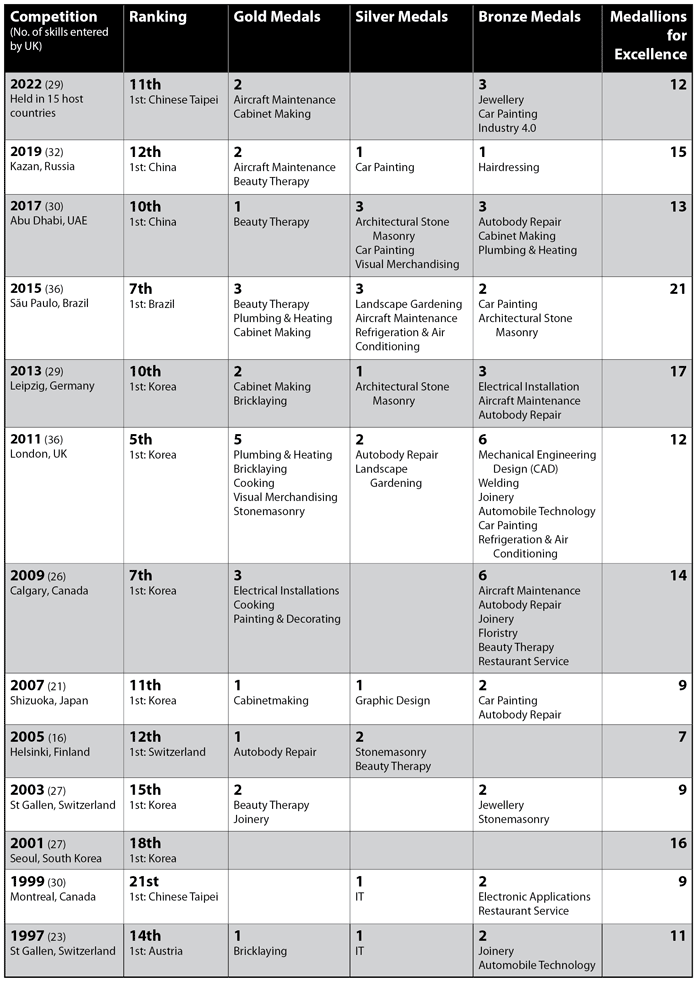
UK Skills also organises the UK entry to the WorldSkills Competition, which challenges young people, teachers, trainers and employers to achieve world class standards. The WorldSkills Competition is the biggest skills competition in the world, and is an opportunity for competitors to represent their country and their trade abroad. WorldSkills is held every two years and brings together young people from many countries (62 in 2019) to compete in around 50 trade skills, for gold, silver and bronze medals. Medallions for Excellence are also awarded to competitors who achieve an International standard at the Competition. The WorldSkills Competition was held in London in 2011.
The UK's results from past WorldSkills Competitions are shown in the following table:
 |
The Electronics Faultfinding course is used as the first part of the competitors' training.
For more information on Technical Training Solutions' Electronics course, please click
on the following link: Course 570 - Electronic Fault Finding 
If you would like to learn more about the WorldSkills competitions, please click on the following link: WorldSkills UK
Electricians Guide Books Updated to Amendment 2 of the 18th Edition
 The latest Electricians Guide to Good Practice (Brown cover) was released in June 2022 and the Guide to Inspection and Testing (Orange cover) in August 2022. Both books have been updated to reflect the latest requirements of the 18th Edition of the IET Regulations.
We find that many engineers carry the books in their toolboxes / vans / pockets, as their small size makes this possible. The books therefore now have improved bindings and construction, making them more rugged and suitable for long-term use.
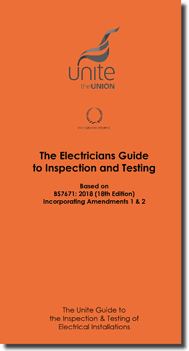
The latest technical changes to the Guide to Good Practice include: The structure was altered so that the book follows the wiring regs itself better; 2 extra stages were added to the design procedure (checking short circuit protection and minimum sizes of cable allowed); Updates about the use of RCDs, RCBOs, AFDDs and SPDs; 2 new sections on protection against thermal effects and protection against voltage disturbances were added; The wording and layout of the special locations section was improved; A new section on prosumers' electrical installations (PEIs) was added. There were various other small changes throughout the book.
Technical changes to the Guide to Inspection and Testing include: The initial inspection section was re-written so that it tallies up with Sec 642 in the Regs; The recommended types of RCDs was added; The various methods of earth electrode resistance test were expanded on; Max Zs for RLV systems was added; RCD testing was updated; The certificates, reports and schedules were updated; Various other small changes including improvements and updates to the drawings.
For further information about the Electricians Guide Books, please click here.
Cancer Research Shops learn about Portable Appliance Testing
Technical Training have employed their extensive knowledge and experience of Portable Appliance Testing and their competence-based approach to learning about the subject to enable Cancer Research South to perform safety checks on electrical appliances. This has allowed Cancer Research South to access a totally new revenue stream to aid in their charitable works by allowing shop staff to ensure the safety of electrical appliances and thereby to sell donated appliances which, before training, they were unable to accept.
Candidates are not expected to have any prior knowledge or experience of PAT testing or electrical work. All candidates are provided with course notes, help and advice about which model of PAT tester would be most appropriate for them and given on-going telephone support from Tech Training's technical staff. The courses are being provided on an on-going basis throughout 2006 and 2007 across the south of England. The training courses have been provided at cost price to Cancer Research South as part of Tech Training's charitable works.
Libby Dey of Cancer Research South said, "These new training courses will allow us to provide a valuable new service to our customers, as donators and buyers at the shops will see an improved service and ultimately the needy causes that we represent will benefit."
Technical Training have been treating these courses as the ultimate accolade for their 'learning by doing' approach: being clear about what should be taught, who the target audience is and ensuring that the candidates are able to use these skills for real when they return to work.
For a description of the PAT course, go to:
Course 160 - PAT: Inspection and Testing of portable electrical appliances
For more information about Cancer Research South's charitable activities, go to Cancer Research
Technical Training Solutions' Trademark

Technical Training Solutions uses a trade mark which was granted
by the British Patent Office.
The 'Learning by Doing' approach to training espoused by Technical Training has been the basis to all the engineering skills training provided over the years. This approach leads to better understanding, retention and enjoyability of the courses on offer.
The ancient Chinese proverb captured this idea:
'Tell me and I'll forget, show me and I'll remember, involve me and I'll understand'. The logo reinforces this approach.
Technical Training now based in Rochester
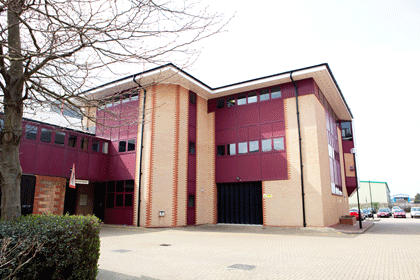
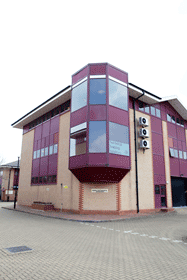
Due to the increasing demand for scheduled training courses, we moved into larger premises in 2004 at Rochester, Kent. Norwich House has several training rooms, each ideally suited for a particular range of courses, spread over three floors of the building.
 |
 |
Candidates attending mechanical courses enjoy the use of a fully-equipped, bright and spacious workshop area, fitted out with heavy-duty workbenches, pillar drills, grinding machines, hydraulic presses, etc. Candidates attending electrical courses use the large seminar room which is fitted out with a practical experiments area, so that they can explore the technical issues that they are learning about on our custom-built low-voltage rigs. Other training rooms can be used for specialist courses like Instrumentation, PLCs and AC Drives.
Norwich House has a large car park where delegates can leave their cars in safety and within 5 or 10 minutes drive there is a good selection of three-star hotels, B&Bs, etc. Good transport links allow delegates travelling from anywhere in the UK to reach us easily. Delegates travelling to Norwich House are provided with straight-forward maps and instructions on how to get there by road, rail and public transport.
We look forward to seeing you at Norwich House soon.
Electrical maintenance skills course goes from strength to strength
Now regarded as the industry standard for many companies, the industrial electrical maintenance course (course 110) has been provided to over 5 thousand engineers in the UK and has provided many companies with increased flexibility and productivity and also enhanced the value of their maintenance teams.
Importantly, the course covers the legal aspects of working with electricity so that candidates really do understand what the dangers are and they get the chance to practice their skills in a safe and controlled manner. The scheme can also be used to help employees decide when supervision is no longer necessary ie when competent.
The course is now offered in a two week, 5 day format totalling 10 days. Our latest course brochure provides more details.
Where's the competence in skills training?
Many modern skills training courses offer a certificate at the end of the course, but too often this is an attendance-based certificate which simply says that the delegate was actually there for the duration of the course.
Other training courses have a short multiple-choice examination, and delegates have to answer questions about the subject. This is useful for checking that the delegate has the appropriate understanding of the subject, but too often this is the only form of assessment that is made.
Skills training must lead to the delegates acquiring that skill, and for this reason training courses should have practical assessments, and this is what employers actually want.
When delegates return to work after having attended a course, many managers will automatically assume that they are now able to perform these new skills in the workplace, but from a legal point of view this assumption would have no basis, since there is no direct evidence upon which the delegate's competency can be determined.
If, however, the delegates had been given a practical assessment, then this could be used as part of the evidence for competency. The delegates would also need to be shown how the new skills they have learned would actually be used in the workplace, and therefore some degree of supervision and mentoring in the workplace would be needed to ensure that they are shown how to do this.
Courses which have practical outcomes are also more enjoyable for the delegates attending them, since they would be much more practical by their very nature - avoiding the long lectures and powerpoint presentations so often used on training courses today.
Technical Training Solutions provide courses that are skills-based and practical assessments are carried out by all the candidates. This means that at the end of any course provided by us, a candidate will have demonstrated an ability to perform a new skills that he/she was not able to perform before attending the course.
